Formwork Pressure Calculations: What Your Temp Works Coordinator Wants You to Know
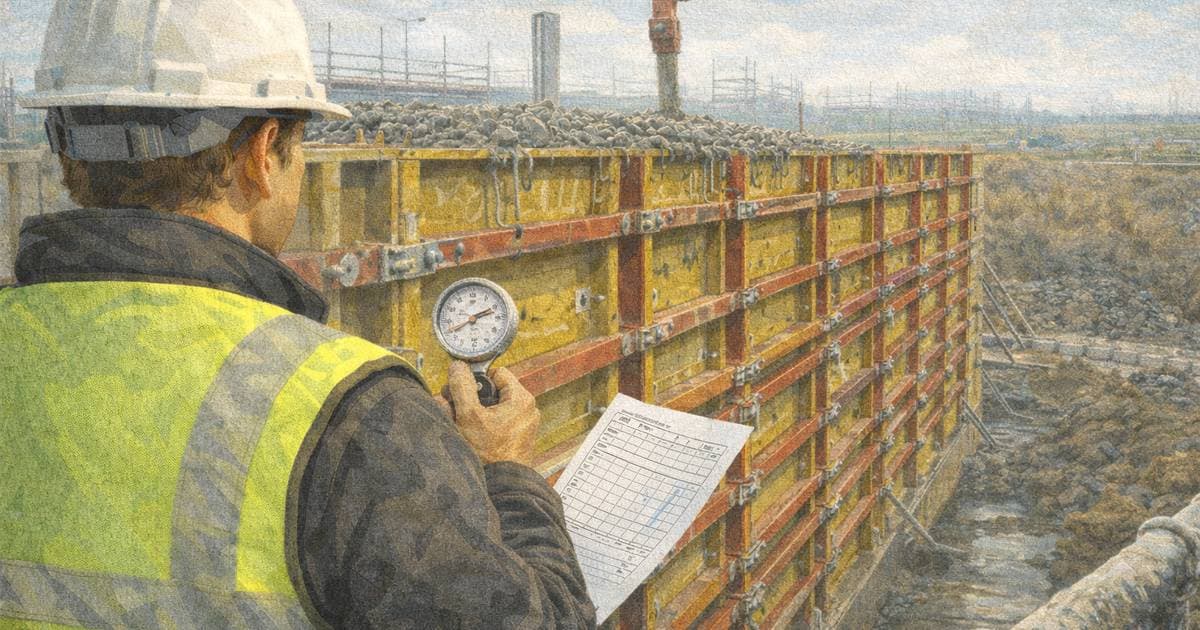
The Day the Shutters Gave Way
Early in my career I was on a job where a 2.5-metre wall pour blew a shutter. The tie bolts on the lower section hadn't been torqued properly, and about two cubic metres of wet concrete burst through the formwork and spread across the blinding like lava. Nobody was hurt — pure luck, because two labourers had been standing exactly there five minutes earlier. But the rework cost, the programme delay, the investigation, and the near-miss report that went all the way up to the client made it a very expensive lesson. And it started with someone not understanding the forces involved.
How Lateral Pressure Works
Fresh concrete behaves like a fluid for the first few hours after placement. It exerts lateral (sideways) pressure on the formwork, and that pressure increases with depth — just like water pressure in a swimming pool. The deeper the pour, the higher the pressure at the bottom. A column of wet concrete 3 metres deep exerts a lateral pressure of roughly 72 kN/m² at the base. That's over 7 tonnes per square metre pushing outwards on your shutters.
But it's not quite as simple as hydrostatic pressure, because concrete starts to set. As it stiffens, it supports its own weight and the lateral pressure stops increasing. The rate of pour, the temperature, the cement type, and any admixtures all affect how quickly this happens. A fast pour rate means the concrete at the bottom hasn't had time to stiffen before more concrete is piled on top, so the pressure keeps climbing. A slow pour gives the lower layers time to gain strength and reduce the pressure.
CIRIA Report 108
In the UK, formwork pressure calculations are typically done using CIRIA Report 108 (now superseded by C580 and C660 in some contexts, but 108 is still widely used in practice). The method considers pour rate (m/hour), concrete temperature, the shape of the form (wall versus column), and the type of cement. It produces a design pressure envelope that the formwork must resist.
The basic formula for walls gives a maximum pressure that depends on the pour rate and the concrete temperature. At a pour rate of 3 m/hour and a concrete temperature of 15°C, the maximum lateral pressure on a wall is roughly 60 kN/m² — regardless of the total depth, because the concrete below that point has stiffened enough to be self-supporting. But at a pour rate of 6 m/hour, the pressure can exceed 90 kN/m².
Columns are worse. Because of the smaller cross-section, the concrete doesn't lose heat as quickly, so it takes longer to stiffen. For a column with a cross-section under 500mm, full hydrostatic pressure is often assumed for the entire depth — no relief from stiffening.
Using the Calculator
Ebrora's Formwork Pressure Calculator implements the CIRIA method. You enter the pour height, pour rate, concrete temperature, cement type, and element type (wall or column), and it calculates the maximum lateral pressure, the pressure envelope, and the depth at which maximum pressure occurs. It takes thirty seconds and gives you a number you can check against the formwork design.
This isn't a substitute for the formwork design itself — that's the TWC's responsibility and it typically involves structural calculations for the tie spacing, waler sections, and soldier sizes. But it gives you a reference point. If the design says the formwork is rated for 60 kN/m² and your pour conditions produce a calculated pressure of 55 kN/m², you're within tolerance. If the calculated pressure is 75 kN/m², something needs to change — either the pour rate, the concrete mix, or the formwork.
What You Can Control on the Day
Pour rate. This is the single biggest lever. Slowing the pour rate reduces the maximum lateral pressure significantly. If the formwork is marginal, slowing the wagons down and placing in thinner lifts can bring the pressure back within the design limit. Agree the target pour rate before the pour starts and monitor it during placement.
Concrete temperature. Warmer concrete stiffens faster and develops lower lateral pressure. In winter, concrete arrives colder and takes longer to set — which means higher pressures and a greater risk of formwork failure. If you're pouring walls in January, the calculation will give you a higher pressure than the same pour in July. Factor that in.
Vibration. Over-vibration re-liquefies concrete that's started to stiffen, which increases the lateral pressure locally. Don't over-vibrate near the base of deep pours. Use the poker to consolidate the concrete, not to push it around.
Inspection. Walk the formwork during the pour. Look for deflection, listen for creaking, check the tie positions. If anything looks wrong, stop pouring immediately. Formwork failure happens fast — the warning signs are subtle and the collapse is sudden.
Talk to your TWC, understand the design pressure, use the calculator to cross-check your pour conditions, and never assume the shutters will hold just because they did last time. See our scaffold load guide for similar principles applied to scaffolding, and the Temporary Works Register for managing your temp works permits and inspections.
Build Better Sites with Our Templates
The templates and systems discussed in this article can save your team hours every week. Explore our full product range to find tools that match your workflow.
Explore Products