Soil Compaction Testing: A Practical Site Guide
Why Compaction Matters
Everything built on the ground is only as good as the ground it sits on. Poorly compacted backfill settles. Settled backfill causes road surfaces to crack, manholes to stand proud, services to fracture, and structures to move. On a water industry site, a settled pipe run can change the gradient, causing flow issues that persist for decades. On a highway scheme, a settlement of even 20mm can trigger a defect that costs more to repair than the original backfill operation.
Compaction testing proves that the fill material has been placed and compacted to the required standard. Without it, you're relying on assumption — and assumption is not a valid engineering methodology.
The Specification
In the UK, earthworks compaction is typically specified to the Highways England Specification for Highway Works (SHW), Series 600. The specification defines compaction requirements in terms of either end-product testing (achieving a specified dry density or air voids) or method compaction (achieving a specified number of passes with specified equipment at specified layer thicknesses). The method depends on the material type and the specification clause.
For granular materials (Types 1, 2, 6F1, 6F2, etc.), the specification typically requires end-product testing to demonstrate that a minimum percentage of the maximum dry density has been achieved — usually 95% of the Maximum Dry Density (MDD) from a vibrating hammer compaction test (BS 1377: Part 4). For cohesive fills, the specification often uses air voids criteria — typically less than 5% or 10% depending on the clause.
Testing Methods
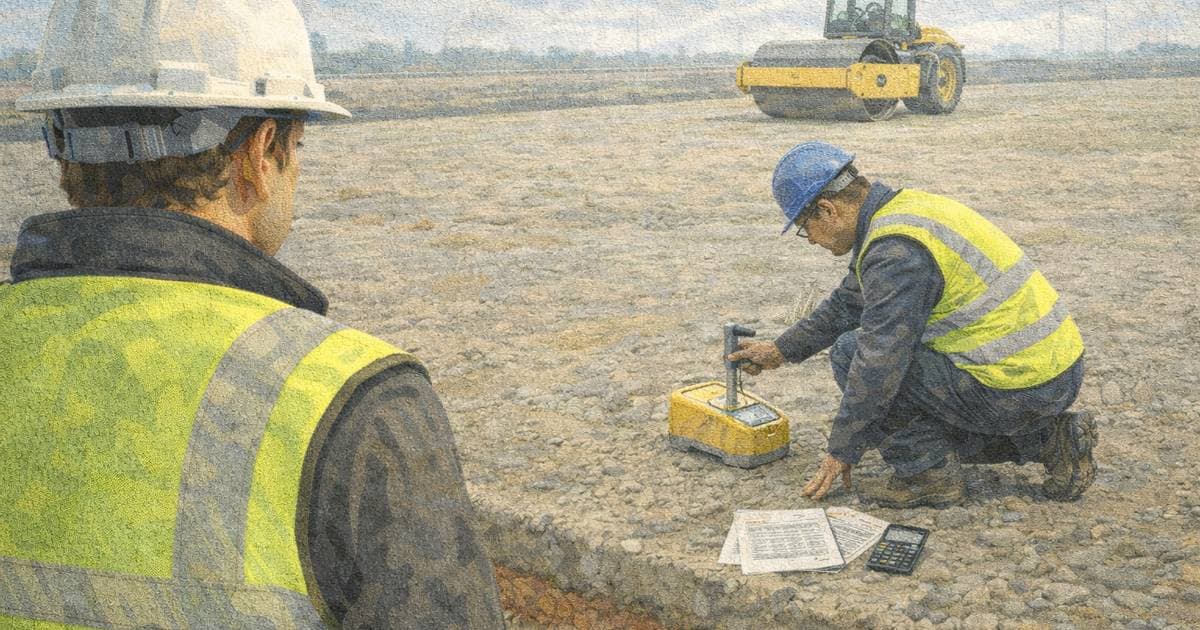
Nuclear density gauge (NDG). The most common site testing method for bulk earthworks. The gauge contains a radioactive source that emits gamma rays into the soil. The degree of attenuation (absorption) of those rays correlates with the soil density. The gauge also measures moisture content using a neutron source. Results are available in about one minute per test point.
NDGs require a trained and certificated operator, and the radioactive source means there are strict regulatory requirements for transport, storage, and use under the Ionising Radiations Regulations 2017. The gauge must be calibrated regularly and the results need to be correlated against laboratory standards.
Sand replacement test. The traditional laboratory-grade method. Dig a hole, weigh the extracted soil, fill the hole with calibrated sand, and calculate the in-situ density from the volume (determined by the sand) and the mass of the extracted material. Accurate but slow — each test takes about 30 minutes, and you need a flat, prepared surface. Not practical for high-volume testing, but useful as a verification method.
Dynamic cone penetrometer (DCP). A quick field test where a standard weight is dropped from a standard height onto a cone that penetrates the soil. The penetration per blow (mm/blow) correlates with the California Bearing Ratio (CBR) and gives an indication of compaction quality. It's not a direct density measurement, but it's fast, cheap, and useful for checking uniformity across a large area.
Interpreting Results
A compaction test result tells you two things: the dry density and the moisture content. You compare the dry density against the MDD from the laboratory proctor test to get the percentage compaction. If the spec says 95% MDD and your field result is 97%, you've passed. If it's 93%, you haven't — but understanding why it failed is more useful than just re-rolling and retesting.
Common reasons for failure include: insufficient compaction effort (not enough passes), wrong lift thickness (too thick for the compactor to fully densify), wrong moisture content (too wet or too dry), and contamination of the fill material (mixing of different soil types). If the moisture content is significantly different from the optimum moisture content (OMC), no amount of rolling will achieve the target density — the material needs to be dried out or wetted up before recompaction.
Ebrora's Soil Compaction Calculator takes your field test results and the laboratory MDD and OMC values, and calculates the percentage compaction, the air voids percentage, and whether the result passes the specified criteria. It also flags if the moisture content is outside the acceptable range and suggests corrective action.
CBR and Bearing Capacity
For sub-base and capping layers, the specification often requires a minimum CBR value rather than (or in addition to) a density. CBR is a measure of the soil's bearing capacity — its ability to support load without excessive deformation. The CBR & Modulus Converter tool converts between CBR, modulus of subgrade reaction, and resilient modulus, which is useful when dealing with specifications that use different parameters.
The Plate Bearing Test Interpreter helps you analyse results from plate bearing tests, which are sometimes required for foundation bearing capacity verification. Enter the loading data and it produces the pressure-settlement curve and the modulus of subgrade reaction.
Documentation
Record every test. Location (chainage and offset or grid reference), date, time, material type, layer number, lift thickness, test method, dry density, moisture content, percentage compaction, and pass/fail. Plot test locations on a plan so you can demonstrate coverage. Gaps in testing are gaps in the evidence, and a missing test at the location where the settlement occurs five years later is a very expensive gap.
Build the testing frequency into your programme. The spec will define the minimum frequency — typically one test per 250m³ or one per layer per section — but you'll often need more than the minimum to satisfy the engineer. Agree the testing plan with the clerk of works before you start placing fill, and stick to it. Consistent, well-documented compaction testing is one of those things that nobody notices when you do it right, and everybody notices when you don't.
Build Better Sites with Our Templates
The templates and systems discussed in this article can save your team hours every week. Explore our full product range to find tools that match your workflow.
Explore Products