Toolbox Talks That People Actually Listen To
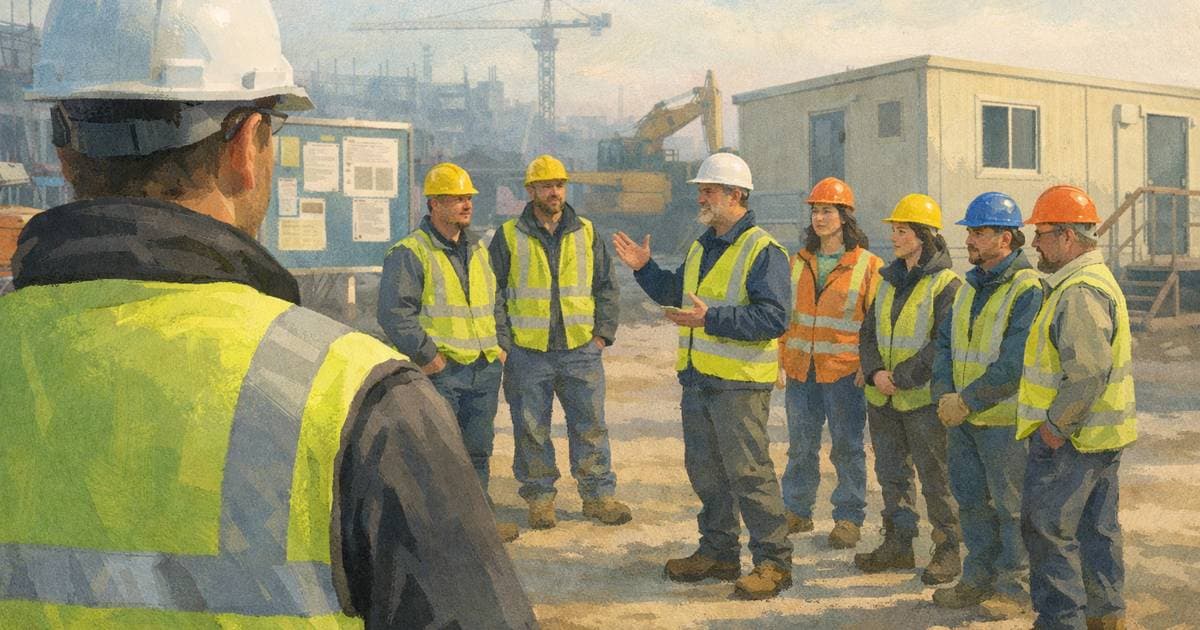
Be Honest — Your Toolbox Talks Are Boring
I sat through a toolbox talk last winter on the topic of slips, trips and falls. The supervisor stood in the canteen, read word-for-word from a sheet he'd printed off some health and safety website, asked "any questions?" to a room full of people who clearly had no intention of asking anything, got everyone to sign the attendance sheet, and moved on. Total time: four minutes. Total impact: zero. Everyone already knew that wet surfaces are slippery. Nobody learned anything, nobody changed their behaviour, and the only purpose served was putting a signed sheet in the H&S file.
That's not a toolbox talk. That's a compliance ritual. And it's a wasted opportunity, because when they're done well, toolbox talks are genuinely one of the most effective safety interventions on a construction site. They're the only regular moment where the entire team stops, gathers in one place, and has a conversation about how to keep each other alive. The trick is making that conversation worth having.
Make It About Something That Happened
The talks that land best are the ones tied to a real event. A near miss on your site. An incident in the news. Something that went wrong last week that everyone saw. "Yesterday, a brick fell off the scaffold on Section 3. Nobody was hurt, but the exclusion zone wasn't set up properly. Let's talk about why that matters." That's immediately more relevant than a generic sheet about falling objects, because it happened here, to us, and people can picture it.
If nothing specific has happened recently, use seasonal relevance. In autumn, talk about reduced daylight and visibility. In summer, talk about heat stress and UV exposure. During a period of heavy plant activity, talk about blind spots and segregation. Match the talk to what's actually happening on site that week.
Stop Reading and Start Talking
Put the sheet down. You can have notes — a few bullet points to keep you on track — but if you're reading a pre-written script, you've already lost the room. People listen to other people, not to documents. Make eye contact. Use plain language. Tell a story if you've got one. "When I was on the A56 job, we had a lad who..." — that gets attention in a way that "employees must ensure that the workplace is free from hazards" never will.
Ask questions that require actual answers, not yes or no. "What would you do if you saw someone working without their harness clipped on?" is better than "should we all wear our harnesses?" One starts a conversation. The other gets a bored mumble of agreement.
Keep It Short
Ten minutes, maximum. If you can do it in five, even better. The goal isn't to deliver a lecture — it's to land one clear message that sticks. If people walk away remembering one thing, that's a success. If you try to cover three topics in fifteen minutes, they won't remember any of them.
Get the Content Right
Ebrora's Toolbox Talks Library has over 1,500 talks across 60 categories, covering everything from abrasive wheels to zoonotic diseases. Each one is written in plain language with a clear structure: what the hazard is, why it matters, and what to do about it. You can view them on screen during the briefing or generate a PDF to print and file.
The library is free to use. Browse by category — working at height, manual handling, plant and machinery, COSHH, electrical safety, excavations, confined spaces — or search for a specific topic. Each talk includes a sign-off section for attendance records.
Rotate the Delivery
Don't always give the talk yourself. Get the foremen to take turns. Get the banksman to talk about vehicle movements. Get the scaffolder to talk about access. Get a subcontractor's supervisor to deliver one. When people hear the same voice every day, they switch off. When a different person stands up and talks about something they actually know about from direct experience, the room pays attention.
Follow Up
The talk only works if there's follow-through. If you talked about housekeeping on Monday and by Wednesday the site looks like a skip, you've undermined your own message. If you talked about checking harness lanyards and then don't check them yourself during the afternoon walkround, nobody will take the next talk seriously.
Log the talks, record who attended, and note any actions that came out of the discussion. Not just for the file — but so you can refer back. "Remember three weeks ago we talked about this exact situation? Well, here we are." That continuity is what turns a series of disconnected five-minute chats into a genuine safety culture. Check our compliance tracking guide for tips on managing these records alongside your other H&S registers.
Build Better Sites with Our Templates
The templates and systems discussed in this article can save your team hours every week. Explore our full product range to find tools that match your workflow.
Explore Products