Traffic Management Plans: Getting Them Right on Live Sites
The Statistic That Matters
In the UK, being struck or run over by a moving vehicle is consistently one of the top three causes of fatal injuries on construction sites. The HSE data is stark: dozens of deaths and hundreds of serious injuries every year, many involving dump trucks, excavators, or delivery vehicles on sites where the traffic management was either absent, inadequate, or routinely ignored.
The thing about vehicle incidents is that they're almost always catastrophic. A pedestrian struck by a 30-tonne articulated dump truck at walking speed doesn't get a broken leg — they die. There's no "near miss" equivalent of being half run over. That's why traffic management planning deserves more attention than it typically gets on construction sites.
What a Traffic Management Plan Needs to Cover
A TMP isn't just a drawing showing one-way arrows. It's a document that addresses the full system of vehicle and pedestrian movement on site. That includes:
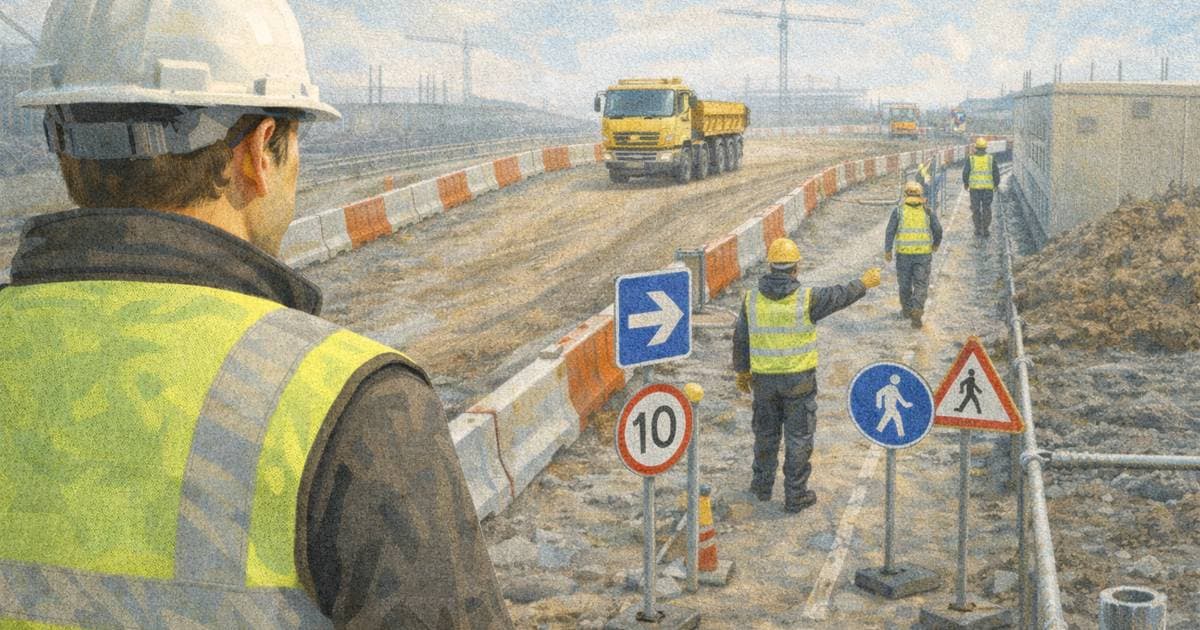
Segregation. Physical separation of vehicles and pedestrians wherever possible. Barriers, designated walkways, separate access points. If people and plant share the same route, one of them needs to be somewhere else. Where full segregation isn't practicable — and on tight sites it often isn't — controlled crossing points with banksmen and physical barriers are the minimum.
Speed limits. Typically 10 mph on site, sometimes 5 mph in confined areas. Speed limits are meaningless without enforcement. Speed bumps, rumble strips, and visual narrowing (chicanes) are more effective than signs because they force compliance rather than requesting it.
Signage and markings. Clear, consistent, and visible. Construction site signage should follow the same conventions as public highway signage so that everyone — including delivery drivers who've never been on your site before — understands them instinctively. Ebrora's Construction Sign Maker generates site-specific signage you can print and laminate.
Reversing. Eliminate it where you can. One-way systems, turning areas, drive-through loading bays. Where reversing is unavoidable, it must be controlled by a trained banksman with clear communication protocols. Most vehicle-pedestrian fatalities on construction sites involve reversing vehicles.
Delivery management. Pre-book deliveries. Control arrival times. Brief every visiting driver at the gate on the site rules, speed limit, unloading point, and pedestrian areas. Don't let an unfamiliar HGV driver loose on a busy site without a briefing.
Making the Plan Live
The best TMP in the world is useless if nobody follows it. The plan needs to be briefed to every person on site — not just pointed at on the wall, but actively explained during induction and reinforced during daily briefings.
Walk the routes. Physically walk the pedestrian routes and check that they're clear, lit, and free of obstructions. Drive the vehicle routes and check that visibility is adequate at junctions and crossing points. Do this weekly at minimum, daily if activities are changing the layout.
Update it when things change. A new excavation across a haul road changes the vehicle route. A new subcontractor mobilising with their own plant changes the traffic density. A crane set-up changes the pedestrian access. Every change should trigger a review of the TMP, not just a mental note to "be careful."
AI-Generated Traffic Management Plans
Ebrora's Traffic Management Plan Builder generates a structured TMP document from your site information — layout, vehicle types, pedestrian areas, delivery schedules, and high-risk zones. The AI produces a comprehensive plan covering all the elements above, formatted as a Word document ready for site management review and PC approval.
It doesn't replace a site-specific risk assessment or a physical walkover — nothing does. But it gives you a solid first draft that covers all the bases and saves you writing from scratch every time you mobilise on a new site.
The Human Factor
Technology helps, but this is fundamentally about people. Plant operators who check their mirrors. Banksmen who stay alert. Pedestrians who use the walkways instead of cutting across the haul road because it's quicker. Supervisors who challenge non-compliance every single time, not just when the client's on site.
Put it on the briefing sheet every morning. "Today's vehicle movements: four wagon loads of backfill in the morning, concrete delivery at 13:00, telehandler operating in the compound until 15:00. The pedestrian walkway past the compound is closed until 15:00 — use the alternative route via the western gate." That specificity is what keeps people alive. If your daily briefing doesn't mention traffic, your traffic management isn't working. For printable signage, the Sign Maker is free and covers standard construction site safety signs and custom text signs.
Build Better Sites with Our Templates
The templates and systems discussed in this article can save your team hours every week. Explore our full product range to find tools that match your workflow.
Explore Products