Construction Noise Exposure: Limits, Measurement, and What to Do About It
The Numbers Nobody Remembers
The Control of Noise at Work Regulations 2005 set two action values and one limit value. The lower exposure action value is 80 dB(A) daily personal exposure, or 135 dB(C) peak. The upper exposure action value is 85 dB(A) or 137 dB(C) peak. The exposure limit value — the absolute ceiling that must not be exceeded — is 87 dB(A) or 140 dB(C) peak, taking into account any hearing protection worn.
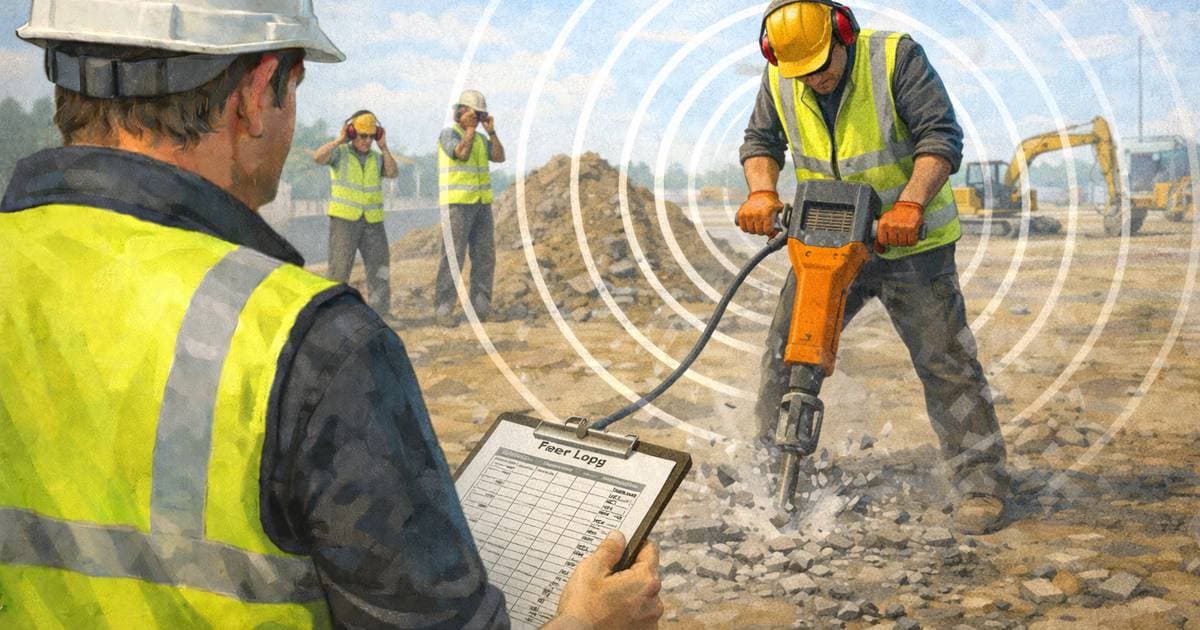
Those numbers sound abstract until you put them in context. A standard petrol disc cutter operates at about 105–110 dB(A) at the operator's ear. An unsilenced pneumatic breaker is around 100–105 dB(A). Even a hand-held grinder pushes 95–100 dB(A). Exposure is calculated on an eight-hour average, but the maths is logarithmic — it doesn't work the way people expect. Two hours at 100 dB(A) produces the same daily dose as eight hours at 94 dB(A). Short bursts of loud noise matter far more than most people realise.
Why It Gets Ignored
Nobody wakes up one day and discovers they're deaf. Noise-induced hearing loss happens gradually, over months and years of accumulated exposure. There's no immediate pain, no visible injury, no blood. By the time someone notices they're turning the telly up louder or can't follow a conversation in the pub, the damage is done and it's permanent. That slow onset is exactly why sites don't take it seriously enough. If using a breaker caused instant agony like touching a hot surface, everyone would wear ear defenders. But it doesn't, so they don't.
The other factor is culture. Ear defenders are uncomfortable, they make communication harder, and on a busy site people take them out to hear instructions. That's a supervision problem, not a PPE problem. If your communication system relies on shouting over the noise, your communication system is broken.
Assessing Exposure Properly
A noise assessment doesn't require expensive equipment for every situation. If the task involves power tools, cutting, breaking, piling, or any plant with a decibel rating above 80 dB(A), you know you're above the lower action value and need to act. The manufacturer's declared noise level is the starting point — it'll be in the handbook or on the data plate.
Ebrora's Noise Exposure Calculator takes the noise level and the duration for each task and calculates the daily personal exposure. You can add multiple tools and activities across a shift and it tells you where the operative lands relative to the action and limit values. It's far quicker than doing the logarithmic maths by hand, and it gives you a documented record for the assessment file.
For a formal written assessment, the Noise Assessment Builder generates a complete document with noise source identification, exposure calculations, control measures, and PPE specifications. That covers you for CDM audits and client inspections.
The Hierarchy of Control
Hearing protection is the last resort, not the first. The regulations require you to reduce exposure at source before you reach for the ear defenders box.
Elimination. Can you avoid the noisy process entirely? Sometimes yes. Hydraulic splitting instead of percussive breaking. Diamond wire cutting instead of disc cutting. These alternatives exist but they cost more, which is why they need to be planned into the programme and priced at tender stage.
Substitution. Quieter equipment exists for most tasks. A silenced compressor versus an unsilenced one. A battery-powered cut-off saw versus a petrol one. The difference can be 10–15 dB(A), which in logarithmic terms is massive.
Engineering controls. Barriers, enclosures, damping. If you've got a fixed generator that runs all day, an acoustic enclosure can drop the noise reaching nearby workers by 15–20 dB. If you're doing concrete breaking adjacent to an occupied office, a temporary acoustic barrier is a reasonable and effective control.
Administrative controls. Limit exposure time. Rotate workers. Schedule the noisiest tasks when fewer people are nearby. Simple, free, and often overlooked.
PPE. When you've done everything above and the exposure is still above the upper action value, hearing protection becomes mandatory. But it has to be the right type, it has to fit properly, and it has to be worn for the entire duration of exposure. Ear defenders that get taken off for five minutes in an eight-hour shift reduce effective protection by about 10 dB — which can be the difference between being within the limit and breaching it.
Recording and Monitoring
Keep a noise register. List every significant noise source on site, its typical level, the tasks associated with it, the control measures in place, and the hearing protection assigned. Review it when new plant arrives or activities change. If operatives are regularly exposed above the upper action value, they're entitled to health surveillance — annual audiometric testing through an occupational health provider. That's not optional, and the results need to be kept for at least 40 years.
Noise doesn't get the attention that working at height or excavation safety gets, but the number of people it affects is far larger. Get your assessments done, make the controls real, and make sure your team understands that hearing damage is forever. A two-minute check with our calculator at the start of shift could save someone's hearing for life.
Build Better Sites with Our Templates
The templates and systems discussed in this article can save your team hours every week. Explore our full product range to find tools that match your workflow.
Explore Products