Heat Stress on Construction Sites: What Every Supervisor Needs to Know
It Happens Faster Than You Think
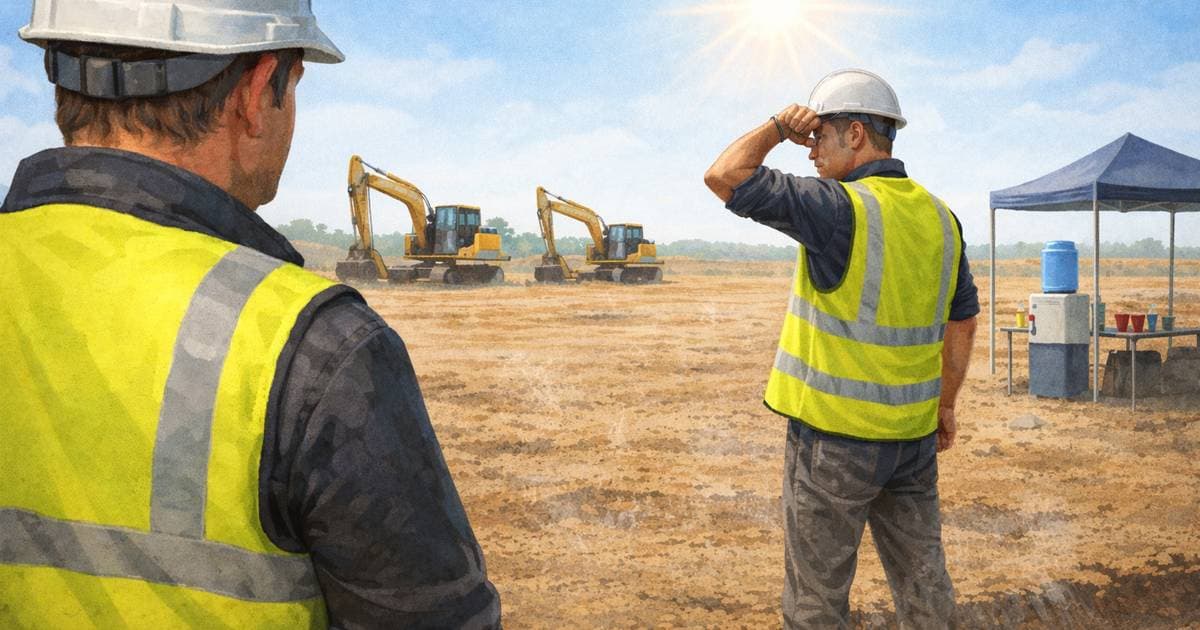
I've seen a banksman drop on a 28°C day in June. Not a heatwave by anyone's definition — just a bloke in full PPE, dark overalls, standing in direct sun for three hours straight with nothing but a half-empty bottle of warm water in his van. He went grey, started slurring, and his mate caught him before he hit the deck. That's heat stress. It doesn't wait for headlines about record temperatures. It just needs the right combination of workload, clothing, humidity, and a lack of shade.
The Health and Safety Executive is clear on this: employers have a legal duty under the Management of Health and Safety at Work Regulations 1999 to assess the risk of heat stress and act on it. The Workplace (Health, Safety and Welfare) Regulations 1992 require a "reasonable" working temperature, though there's no maximum threshold written into law. That grey area is exactly why so many sites get caught out — there's no magic number that triggers action, so nothing happens until someone collapses.
Understanding WBGT and Why It Matters
If you've only ever looked at the air temperature on your phone, you're missing most of the picture. The Wet Bulb Globe Temperature — WBGT — is the metric that actually tells you how dangerous it is outside. It factors in air temperature, humidity, wind speed, and radiant heat from the sun or nearby surfaces. A tarmac car park in July throws off enough radiant heat to push the WBGT well above the danger line even when the weather app says 25°C.
The ISO 7243 standard sets action thresholds based on WBGT and workload. For heavy physical work — think shovelling, carrying blocks, pulling hoses — the threshold drops to just 23°C WBGT. That's a temperature most people wouldn't even complain about indoors. But add a hard hat, hi-vis vest, safety boots, and sustained physical exertion, and suddenly you're in trouble.
Ebrora's WBGT Heat Stress Calculator lets you plug in the conditions and get a risk rating straight away. It's free, works on your phone, and takes about thirty seconds. No excuses for not checking.
Spotting the Signs Before It Gets Serious
Heat exhaustion doesn't announce itself politely. The early signs are things that busy supervisors write off every day: headaches, dizziness, excessive sweating, muscle cramps, irritability. The problem is that by the time someone's confused, stopped sweating, or gone pale, you're dealing with heat stroke — a medical emergency that can cause organ damage or death.
Train your team to look out for each other. Buddy systems work. If your mate's gone quiet and looks flushed, that's worth a conversation. The macho culture on sites is the biggest barrier here. Nobody wants to be the one who says they need to sit down. So make it normal. Build rest breaks into the programme on hot days. Put it on the briefing sheet. Make shade and cold water as visible and accessible as the fire extinguisher.
Practical Controls That Actually Work
Let's skip the obvious stuff like "drink water" and talk about what actually moves the needle on a live site.
First, reschedule heavy tasks. If you've got a concrete pour or a heavy lift planned, push it to the early morning. Start at 06:00 if you can — most of the serious work gets done before 11:00 on hot days anyway, because productivity tanks in the afternoon heat regardless.
Second, think about your temporary works and welfare setup. Is there shade near the active work area, or is the nearest shelter a ten-minute walk to the cabin? Portable shade structures, even a pop-up gazebo from Screwfix, can make a real difference. Cool water stations should be within a couple of minutes of every work face.
Third, review your PPE requirements. Full-length sleeves and heavy-duty overalls might be justified for COSHH work, but if someone's doing general labouring they might not need all of it. Talk to your H&S team about lighter alternatives.
Fourth, monitor it. Check the WBGT at the start of shift and again at midday. If conditions change, your controls need to change with them. A simple log in your daily diary — even just a note saying "WBGT checked at 10:00, 24°C, rest breaks implemented" — shows the auditor that you took it seriously.
Your Legal Duties in Plain English
Under CDM 2015, the principal contractor has to plan, manage and monitor the construction phase so it's carried out without risk to health. That includes heat stress. The site manager's duty under the Management Regs is to do a suitable and sufficient risk assessment — and to review it when conditions change. "Conditions change" absolutely includes a forecast of 30°C.
If someone suffers heat stroke on your site and you can't show that you assessed the risk and put controls in place, you're exposed. Not just to an HSE investigation, but to civil claims down the line. HAVS and noise exposure get all the attention in occupational health, but heat illness claims are on the rise.
Don't Forget UV Exposure
Heat stress and UV exposure are related but different risks. You can get sunburnt on a cloudy day with no heat stress at all. Construction workers are in the top five occupations for skin cancer in the UK, and it's almost entirely preventable. Ebrora's UV Index Exposure Checker tells you the UV risk for any UK location and date, so you can make informed decisions about sun cream, shade, and work scheduling. Check our UV exposure article for more on this.
Heat stress isn't a summer-only problem, and it isn't somebody else's responsibility. It sits squarely with whoever's running the site on the day. Get the WBGT checked, plan the work around the conditions, and make sure your team knows it's alright to say when they're struggling. That costs nothing, and it might save a life.
Build Better Sites with Our Templates
The templates and systems discussed in this article can save your team hours every week. Explore our full product range to find tools that match your workflow.
Explore Products