Plant Pre-Use Checks: Why Kicking the Tyres Doesn't Count
The Five-Second Inspection
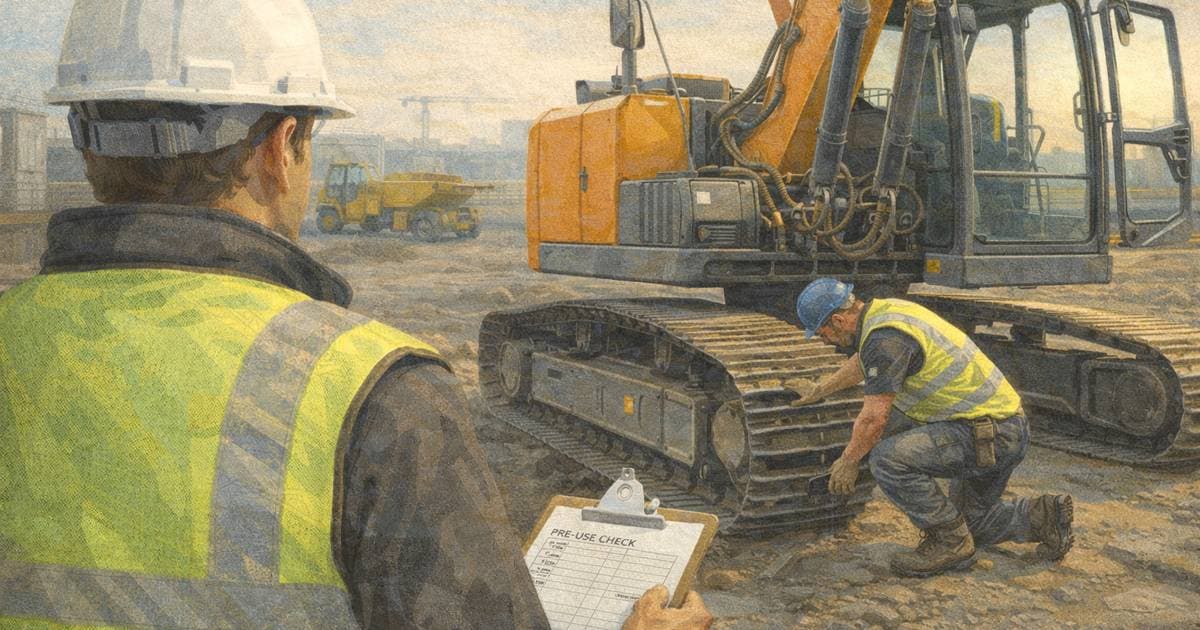
I watched an operator walk up to a 13-tonne excavator, climb in, start the engine, and drive off — all within about thirty seconds. No walk-around. No check of the hydraulic hoses. No look at the tracks. No mirror adjustment. His pre-use check sheet was signed before he left the cabin. That's not a pre-use inspection — that's a liability waiting to happen, and it's repeated on sites across the country every single morning.
The Provision and Use of Work Equipment Regulations 1998 (PUWER) require that work equipment is maintained in an efficient state, in efficient working order, and in good repair. Regulation 6 specifically requires inspection where there's a significant risk from the condition of the equipment deteriorating. For construction plant, that means a pre-use check before every shift.
What a Proper Pre-Use Check Covers
A meaningful walk-around on an excavator takes about five minutes. Start at the front, work clockwise, and check every zone systematically.
Tracks and undercarriage. Track tension, missing or damaged track pads, idler and roller condition, debris wrapped around sprockets. A thrown track on a 20-tonner shuts down your excavation for a day.
Boom, dipper, and bucket. Visible cracks in the steelwork, worn or missing bucket teeth, pin retention, hydraulic ram condition and any visible leaks. A hydraulic hose failure at full pressure can inject fluid through skin — that's a surgical emergency.
Cab. Mirrors set correctly, seatbelt functional, all glass intact, controls responsive, warning lights clearing on start-up, wiper and washers working. If the operator can't see properly, nothing else matters.
Engine and hydraulics. Oil levels, coolant levels, visible leaks, fan belt condition, air filter housing secure. Check the previous day's hourly meter reading against the current one — if the machine ran significantly more hours than expected, ask why.
Safety devices. Reversing alarm audible, beacon working, quick-hitch indicator functioning (if fitted), emergency stop accessible and operational. These are the last line of defence — test them.
Making It Happen in Practice
The reason pre-use checks get skipped isn't ignorance — operators know what to check. It's time pressure and culture. "Just get on with it" beats "do your check properly" every time unless the site management makes it clear that the check is non-negotiable.
Ebrora's Plant Pre-Use Checksheet tool generates printable check sheets tailored to specific machine types — excavators, dumpers, telehandlers, rollers, cranes. Each sheet lists the check points in a logical walk-around order with tick boxes and a defect reporting section. It takes the thinking out of it and gives the operator a structured five-minute routine.
You can also track defects and recurring issues with our Plant Pre-Use Check Sheets Excel template, which logs every check and flags overdue inspections.
What Happens When Checks Find Something
A pre-use check is only valuable if defects lead to action. If an operator reports a hydraulic leak and the machine goes out anyway because "we'll get it fixed at the weekend," you've undermined the entire system. Worse, you've told every other operator that reporting defects is pointless.
Set up a clear defect reporting process: operator reports it, supervisor assesses it, and the machine either goes out with restrictions (minor defect, monitored) or gets taken out of service (major defect, repaired before use). Log everything. The Plant Issues Tracker gives you a register for this — date reported, machine ID, defect description, risk category, action taken, date resolved.
When a defect is found and actioned properly, use it as a positive example. "Good catch on the cracked windscreen this morning — we've swapped the machine out and the new one's in the compound." That reinforces the behaviour you want.
LOLER Overlap
If the machine is used for lifting — and on most civils sites, excavators are used as lifting appliances at some point — the Lifting Operations and Lifting Equipment Regulations 1998 (LOLER) also apply. That means the machine needs a current thorough examination certificate (usually every 12 months, or 6 months if lifting persons), and the lifting accessories (chains, slings, shackles) need their own inspections. Pre-use checks on lifting equipment should include checking that the certificate is in date and that accessories are in good condition and within their SWL. Our Sling SWL Calculator helps you check safe working loads for different sling configurations.
A five-minute check in the morning is the cheapest insurance on any construction site. Do it properly, record it properly, and act on what it tells you. The alternative is a machine failure on a live site — and nobody wants that conversation with the HSE. For wider plant management, see our guide on construction plant management.
Build Better Sites with Our Templates
The templates and systems discussed in this article can save your team hours every week. Explore our full product range to find tools that match your workflow.
Explore Products