Site Welfare Under CDM Schedule 2: The Minimum Standards and Why They Apply From Day One
Welfare Is a Precondition, Not a Milestone
Schedule 2 of CDM 2015 sets out the minimum welfare facilities for construction sites, and the timing rule is the part the industry keeps relearning: the facilities must be in place before construction work starts and maintained throughout. Not "once the compound is established", not "when the cabins arrive in week three" — from the first day there are workers on site. Contractors must ensure welfare for their own workers; the principal contractor must ensure it so far as reasonably practicable for everyone under their control; and the client must ensure arrangements exist for it to be provided. Three duty holders share it precisely because it kept falling between them.
For short-duration and mobile work — the two-day repair, the utility gang moving between locations — the standard flexes but never disappears: agreed access to nearby facilities, welfare vans, or shared arrangements can be legitimate answers where fixed cabins are genuinely impracticable. "The lads use the petrol station" is only an answer if the petrol station has agreed, is genuinely available and within reasonable reach, and the arrangement is real rather than assumed.
What Schedule 2 Actually Requires
Sanitary Conveniences
Suitable and sufficient toilets, adequately ventilated and lit, kept clean, with separate provision for men and women or lockable single rooms usable by anyone. "Sufficient" scales with the workforce — one chemical toilet serving forty people fails the test on arithmetic alone, before you open the door.
Washing Facilities
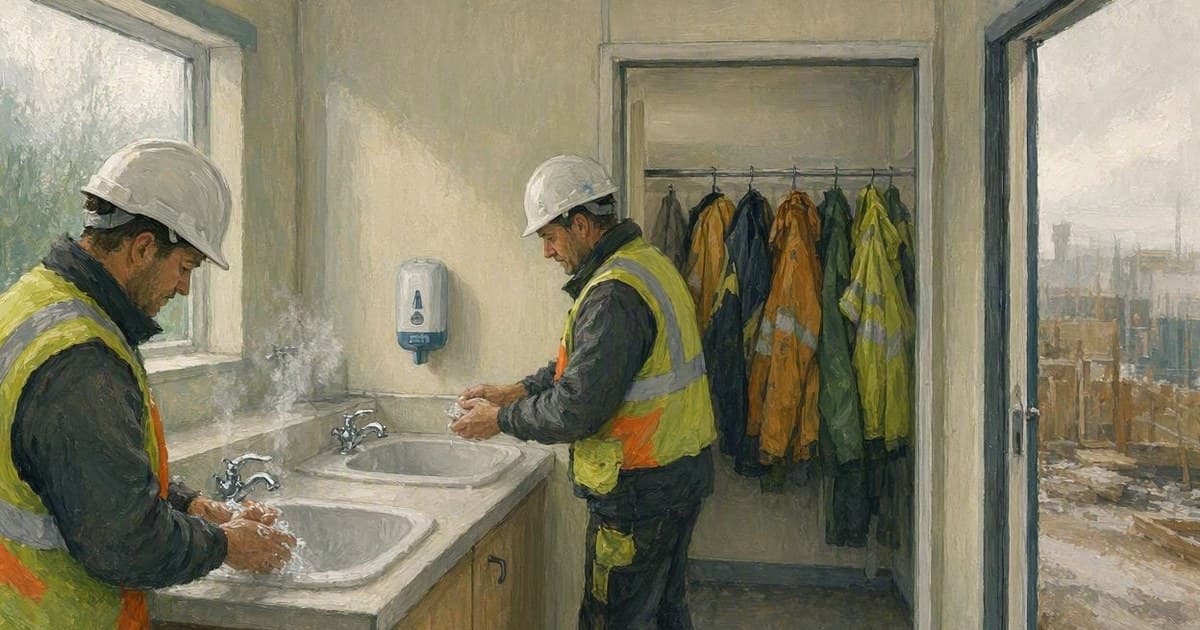
Washing facilities including showers where the nature of the work requires them, in the vicinity of the toilets and changing rooms, with clean hot and cold (or warm) running water, soap and a means of drying. Cold-water-only handwash on a site handling cement, sealants, fuels and contaminated ground is a Schedule 2 failure and an occupational health failure in one — dermatitis remains one of construction's most common and most preventable conditions, and hot water plus proper skin care is the front line against it.
Drinking Water
An adequate supply of wholesome drinking water, marked where necessary, with cups or a fountain. In summer this stops being a formality: outdoor gangs in warm weather need water genuinely available where they work, not a tap 600 metres away behind the compound gate.
Changing Rooms and Lockers
Where workers wear special clothing and cannot reasonably be expected to change elsewhere, changing rooms — separate for men and women where propriety requires — with seating, and facilities to secure personal clothing and to dry wet site clothing. The drying provision is the one that vanishes first and matters most: a workforce that starts Tuesday in Monday's soaked gear is colder, slower and more likely to get hurt.
Rest Facilities
Rest rooms or areas with enough tables and seating for the workers likely to use them at one time, arrangements for pregnant women and nursing mothers to rest, and the means to prepare and eat meals and to boil water — with facilities for making hot drinks and, where hot food cannot reasonably be obtained nearby, for heating food. A dry, warm, clean space to eat is where the morning briefing happens, where the toolbox talk lands, and where a cold, wet gang recovers enough to work the afternoon safely.
Maintained Means Maintained
The duty is continuous, and welfare degrades faster than anything else on site: the hot water fails, the cleaner's visits stretch, consumables run out, and the rest cabin silts up with materials storage. The fix is unglamorous management — welfare on the weekly inspection with the same rigour as scaffolds and excavations, a named person who owns consumables and cleaning, and faults raised and closed like any other defect. Workforce reporting matters too: broken welfare that takes three weeks to fix teaches the workforce exactly how much reporting anything is worth.
The Cheapest Cultural Signal You Can Buy
Inspectors read welfare as a proxy for management, and so does your workforce — usually within an hour of arriving. A site with clean toilets, hot water, a warm dry canteen and a working drying room is telling every operative that the people running the job notice conditions and fix them; that message transfers directly to whether close calls get reported and whether the exclusion zone gets respected. Welfare is one of the few compliance areas where the legal minimum, the productivity case and the culture case all point the same way, and where the entire discipline is simply: provide it from day one, check it every week, fix it fast.
Build Better Sites with Our Templates
The templates and systems discussed in this article can save your team hours every week. Explore our full product range to find tools that match your workflow.
Explore Products