Confined Space Classifications NC1 to NC4: What They Mean and How to Get Entry Right
Why Classification Matters
The Confined Spaces Regulations 1997 give you the legal skeleton: avoid entry where reasonably practicable, and where you cannot avoid it, work to a safe system with adequate emergency arrangements. What the regulations do not do is tell you what "adequate" looks like for a wet well versus a shallow valve chamber. That is where the water industry's National Classification system — NC1 through NC4 — earns its keep. It grades confined spaces by risk and maps each grade to specific training, equipment and rescue requirements, so a site team can look at a classification and know immediately what an entry needs.
If you work on water and wastewater sites for any of the major UK utilities, the classification will be on the asset register or determined by your risk assessment, and your entry teams' training cards will carry the classes they are qualified for. Sending an NC2-trained operative into an NC3 space is not a paperwork problem — it is an untrained person in a space that can kill them.
The Four Classes
NC1 — Low Risk, Shallow, Easy Escape
Think shallow chambers with adequate natural or mechanical ventilation, where the entrant can get out unaided and there is no reasonably foreseeable risk of flooding or atmospheric change. Typical requirements: risk assessment, a top man in communication, gas monitoring appropriate to the space, and unobstructed means of escape. NC1 is still a confined space entry — the class limits the controls, it does not remove them.
NC2 — Medium Risk, Vertical Access, Escape Equipment
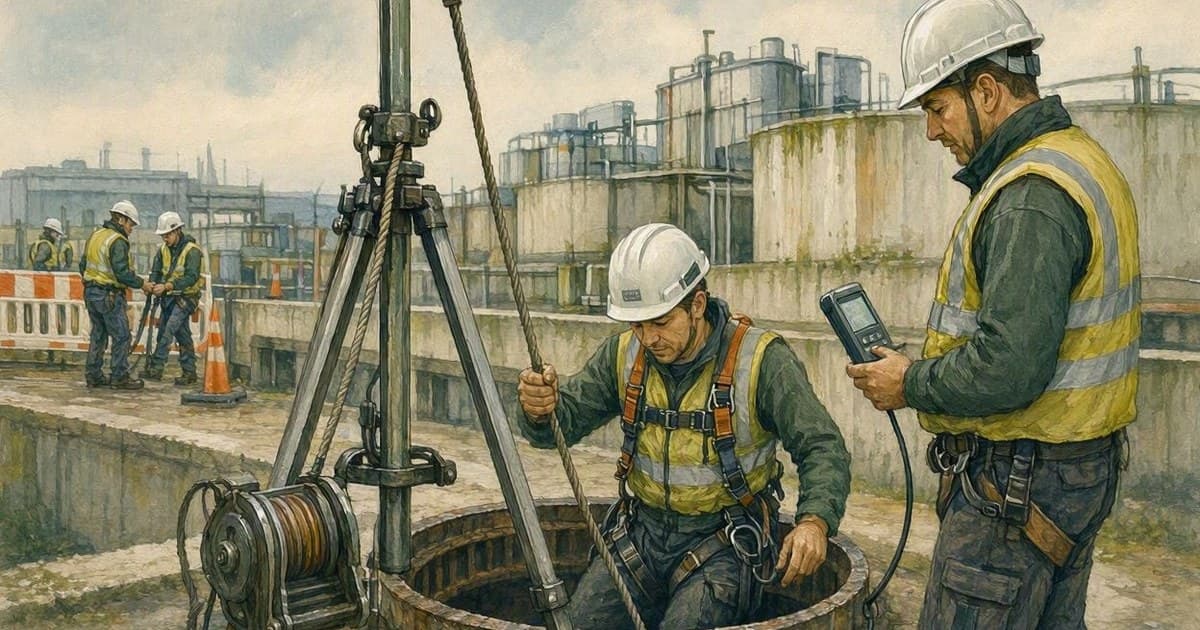
Deeper spaces or those where self-rescue cannot be guaranteed: wet wells, deeper chambers, spaces entered by ladder where a casualty could not simply climb out. NC2 entries typically add harnesses and fall-arrest or retrieval systems, a tripod and winch for vertical access, escape breathing apparatus carried by entrants, and continuous gas monitoring. The top man is now part of a rescue-capable team, not just a lookout.
NC3 — High Risk, Team Entry, Full Rescue Provision
Spaces with significant hazards — larger sewers, long culverts, spaces with a real possibility of atmospheric deterioration or rising flow. NC3 requires a full entry team with dedicated rescue arrangements on the surface, escape sets as a minimum with working-duration breathing apparatus considered, communications appropriate to the space, and detailed emergency planning that has actually been rehearsed. Flow control and isolation upstream become central: you assess what can arrive in that space, not just what is in it now.
NC4 — Complex, Non-Standard, Specialist
Entries that do not fit the standard patterns: unusually long tunnels, spaces requiring full working BA throughout, complex rescue scenarios, or atmospheres that must be actively managed. NC4 work is planned individually by competent specialists — the classification is effectively a flag that says "the standard packages do not cover this."
The Fundamentals That Apply to Every Class
Whatever the class, the sequence does not change. First question: does anyone need to go in at all? CCTV surveys, remote sampling, and reaching tools have eliminated thousands of entries — the safest confined space entry is the one that never happens. If entry is unavoidable, the safe system of work covers isolation of everything that can flow, move or energise; atmosphere testing before and during entry for oxygen, flammables and toxics relevant to the space; ventilation where needed; access and egress equipment matched to the space; and communications that work through the actual geometry of concrete and steel, not just line of sight.
And then rescue — the part that separates a compliant entry from a survivable one. The regulations require suitable emergency arrangements before entry begins. "Call the fire brigade" is not a rescue plan; by the time they arrive, an unbreathing casualty is beyond help. Your rescue provision must be able to reach and recover a casualty within minutes, using people on the surface who are trained and equipped for exactly that space. If the rescue plan has never been walked through with the actual kit at the actual location, it is a theory, not a plan.
Where Entries Go Wrong
The recurring failures are depressingly consistent. Gas monitors that were bump-tested never, worn in the wrong place, or ignored when they alarmed. Isolations that dealt with the pumps but not the gravity flows. Top men pulled away to "just help with something" mid-entry. Escape sets in the van instead of on the entrant. Classification treated as a label rather than a specification — an NC2 space entered with NC1 arrangements because the job was only going to take five minutes. Atmospheres change in seconds and rising water does not read the permit; the five-minute job needs the same controls as the five-hour one.
Get the classification right, match the team and kit to it without negotiation, test the atmosphere like your life depends on it, and rehearse the rescue. Confined spaces are unforgiving of shortcuts precisely because everything looks fine right up until it very suddenly is not.
Build Better Sites with Our Templates
The templates and systems discussed in this article can save your team hours every week. Explore our full product range to find tools that match your workflow.
Explore Products