Site Inductions That Stick: Right-Sizing Content, Killing the Slideshow and Testing What Landed
The Induction Is a Filter and a Contract
Watch a bad induction from the back of the room and you can see the exact moment it fails: slide 14 of 60, corporate policy statement number three, and every operative in the room has mentally left for the workface. They will sign the sheet, because signing is how the room ends. And three hours later one of them will walk a route the induction told them was closed, because the induction told them forty other things too, in a monotone, most of which applied to a different site.
An induction has two honest jobs. It is a filter — the point where you check this person is who they say, holds the tickets they claim, and is fit to be on your site. And it is a contract — the moment you tell them the specific local law of this site and they accept it. Everything in the induction should serve one of those two jobs. Everything else is padding that dilutes the message you actually need to land.
Site-Specific or It Is Not an Induction
The content test is brutal but simple: if a slide would be equally true on any site in the country, it probably belongs in the person's trade training or CSCS knowledge, not your induction. What only you can tell them is what the induction is for. The traffic and pedestrian routes on this site, and where they cross. The permit activities here and how to get one. This site's emergency arrangements — muster points, first aiders, the address you give the 999 operator, the sound of the alarm. The live hazards this month: the deep excavation on the east side, the overhead line corridor, the operational plant you are working alongside, the exclusion zones that will get someone hurt this week, not hazards in general. The welfare, the parking, the deliveries, the hours, the ban list. Who the key people are and what they look like. And how to report — close calls, defects, injuries — with a genuine promise about what happens when they do.
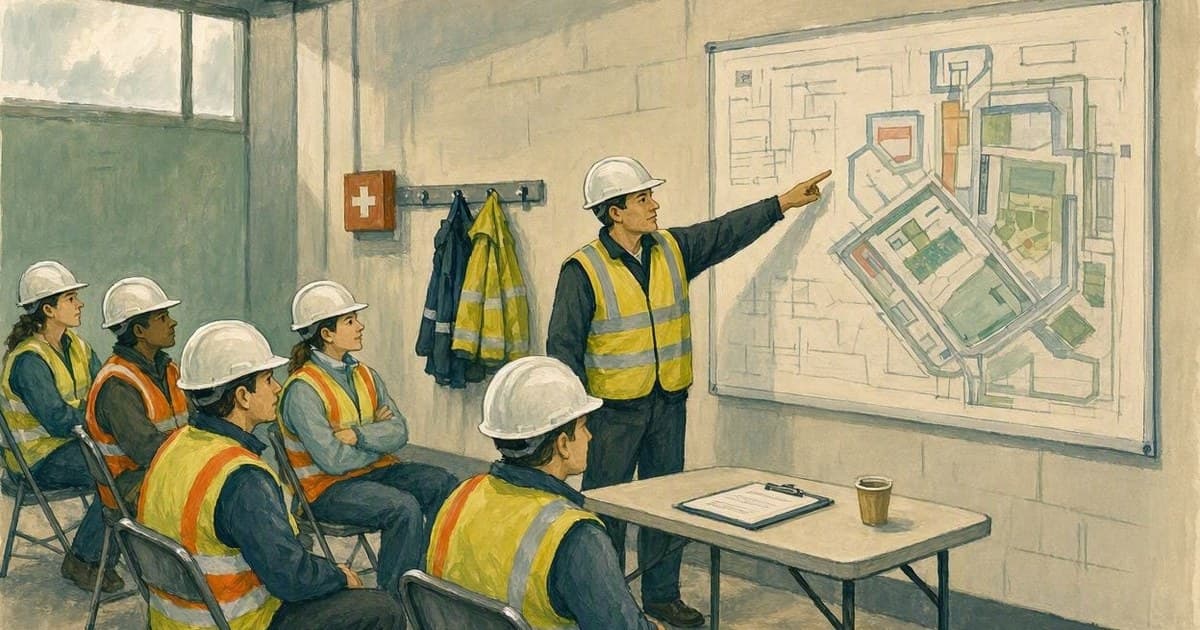
Keep it visual and physical where you can: the site plan people will actually stand in front of, photos of the real hazards rather than clipart, and where practical a walked element for the routes and muster points. People remember the place better than the projector.
Length: Long Enough to Matter, Short Enough to Survive
Attention is a budget and a generic 90-minute deck spends it on the wrong things. For most sites, a focused induction covering identity and competence checks plus genuinely local content lands comfortably inside 30 to 45 minutes; complex or high-hazard environments justify more, and visitor inductions should be a short, honest subset rather than the full ceremony inflicted on someone attending one meeting under escort. The discipline that keeps it short is ownership: someone reviews the deck monthly, deletes what no longer applies, and adds the hazard that arrived with the new phase. An induction that has not changed in a year is describing a site that no longer exists.
Check Understanding, Not Attendance
A signature proves presence. It proves nothing about comprehension — and comprehension is the thing that keeps people out of the exclusion zone. Close the induction with a short check: a handful of questions on the points that genuinely matter here. What do you do if the alarm sounds? Which route do pedestrians take to the east workface? What needs a permit on this site? Keep it conversational rather than an exam, but take the answers seriously — a wrong answer is free information that your induction just failed on that point, and the fix costs two minutes now instead of an incident later. Language matters here too: an induction delivered at speed in English to someone who nodded politely throughout has not been delivered. Know your workforce, use translated materials or a translating colleague where needed, and check understanding in a way that lets someone safely admit they did not follow.
The Records That Make It Real
Behind the induction sits the register: who was inducted, when, on which revision of the content, with which competence cards checked and which expiry dates logged. That last part is where paper systems quietly rot — the CSCS card that expired in March, the fit test that lapsed, the operative inducted on revision 3 of a site now running revision 7. A live register that flags expiries and shows who has not been re-briefed on the current revision turns the induction from a day-one ritual into what it should be: the front door of a site where everyone inside has been checked, told the local law, and understood it. Sites with that front door feel different within a week — and the induction room is the cheapest place on the entire project to change how the job behaves.
Build Better Sites with Our Templates
The templates and systems discussed in this article can save your team hours every week. Explore our full product range to find tools that match your workflow.
Explore Products