BS 5975 Temporary Works: TWC, TWS, Design Checks and the Register That Holds It Together
Why Temporary Works Get Their Own British Standard
Permanent works are designed once, checked at leisure, and built under drawings everyone has seen. Temporary works — the excavation supports, formwork, falsework, propping, haul roads, crane pads, hoarding and edge protection that make permanent works buildable — are designed fast, modified on the fly, loaded in ways drawings never anticipated, and struck by whoever is there when the pour has cured. When temporary works fail, they fail with people inside or underneath them. BS 5975 exists because decades of collapses showed the same lesson repeatedly: the calculations are rarely the weak point; the process around them is. The standard's answer is a procedural control system with named roles, graded checking, and a register that ties it together.
The Roles: DI, TWC and TWS
The Designated Individual sits at organisation level — a senior person who owns the company's temporary works procedure, ensures it is resourced, and appoints the coordinators. It is the role that makes temporary works a corporate system rather than a site-by-site improvisation.
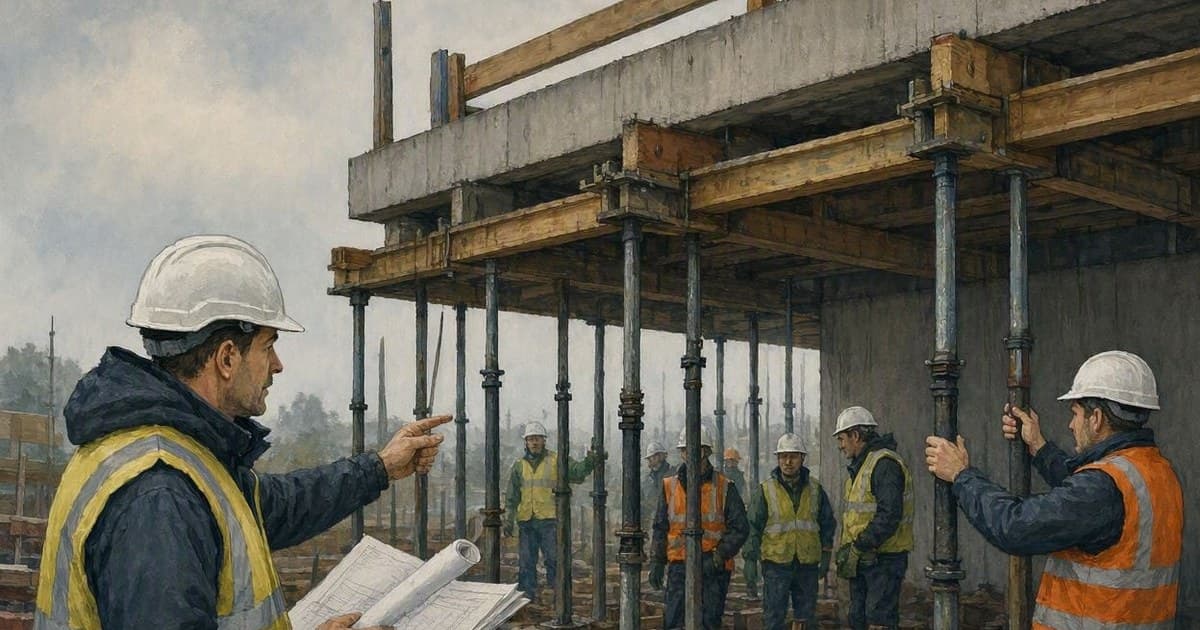
The Temporary Works Coordinator is the pivotal site role. The TWC maintains the register, ensures every item has a design brief and a design, arranges the right category of design check, controls implementation — including the permits to load, proceed and strike where the procedure requires them — and coordinates interfaces between temporary works items and between temporary and permanent works. Crucially, the TWC does not need to be the designer; they need the competence to manage the process and the authority to stop work that runs ahead of it. A TWC who can be overruled by the programme is a title, not a control.
The Temporary Works Supervisor is the TWC's eyes where the work happens — checking that what is built matches the design, that conditions on site match the design assumptions, and that changes go back through the process instead of being absorbed silently. On a large site with multiple fronts, TWSs are what stop the TWC role becoming a desk job.
Design Check Categories 0 to 3
BS 5975 grades the independence of design checking to the risk and complexity of the item. Category 0 covers restricted, standard solutions — proprietary systems used exactly within the supplier's tables, site hoarding to a standard detail — where a check that the standard solution applies is sufficient and can be done by the designer themselves. Category 1 is for simple designs, checked by another person who may be from the same design team. Category 2 covers more complex or involved designs — most engineered falsework, deeper excavation support schemes — checked by someone independent of the original designer, though possibly within the same organisation. Category 3 is for complex or innovative designs, or those with unusually high failure consequences, checked by an organisation entirely independent of the designer.
The category decision is made per item, recorded on the register, and made by someone competent to judge — usually the TWC with designer input. The recurring abuse is category deflation under time pressure: the "simple" prop scheme that is actually carrying a slab over an occupied basement. If a failure would be catastrophic, the check category reflects the consequence, not the page count of the calcs.
The Design Brief Comes First
Most temporary works problems that reach me start with a missing or wrong brief. The design brief tells the designer what the item must do and the conditions it must do it in: loads and load cases including construction stage loading, ground conditions with the investigation data, dimensional constraints, adjacent structures and services, environmental conditions, and how the item will be installed, used and removed. A falsework designer who was never told about the mobile crane tracking alongside, or a shoring designer working to a ground model two boreholes short, produces a correct design for the wrong problem. Writing the brief forces the site team to actually define the problem — which is why skipping it feels fast and costs weeks.
Permits to Load, Proceed and Strike
The physical control points in the process are the hold points: no loading of falsework until the TWC (or TWS on their behalf) has checked the erected structure against the design and issued permission; no striking until the concrete has demonstrably reached its required strength — cube results or maturity data, not the programme's opinion — and permission is issued. These are the moments where the register meets the concrete. Sites that run them formally almost never have the classic failures; sites where "the engineer had a look" substitute for a permit are trusting memory and goodwill with structural collapse.
The Register as the Control Document
The temporary works register is the single list of every item on the project: what it is, where it is, its check category, brief status, design status, check status, who designed and checked it, erection and inspection status, and the loading and striking permissions with dates and names. Run properly, the register answers the only question that matters at any moment — what temporary works exist on this site right now, and is each one designed, checked, inspected and authorised for its current state? Run as a spreadsheet updated monthly for the audit, it answers nothing; items appear on site before they appear on the register, and the register becomes a history book. Review it weekly with the TWSs, walk the items, and treat any structure standing on site that the register does not know about as the emergency it is. Temporary works control is unglamorous, procedural and repetitive — and it is precisely that repetition that keeps the falsework standing while the pour goes in above someone's head.
Build Better Sites with Our Templates
The templates and systems discussed in this article can save your team hours every week. Explore our full product range to find tools that match your workflow.
Explore Products