Face Fit Testing Under INDG479: Qualitative vs Quantitative, and Why Stubble Fails the Test
The Mask Is Only Half the Protection
Hand an operative a brand new FFP3 and you have given them a filter capable of stopping over 99% of the particles that reach it. Whether any protection actually happens depends on the seal between the mask and their face — and faces vary enormously. A mask that seals perfectly on one person leaks around the nose bridge of the next and under the chin of a third. That is the entire reason face fit testing exists: tight-fitting respiratory protective equipment only works if it fits the individual wearer, and the only way to know is to test that wearer in that specific make, model and size.
The HSE's guidance is INDG479, and the legal hook is that RPE provided under COSHH, the asbestos regulations or similar must be adequate and suitable — which for tight-fitting facepieces has been interpreted consistently to require fit testing by a competent person. On most principal contractors' sites it is now simply a condition of entry for anyone whose RAMS put them in a mask.
Qualitative Testing: The Bitter Taste Method
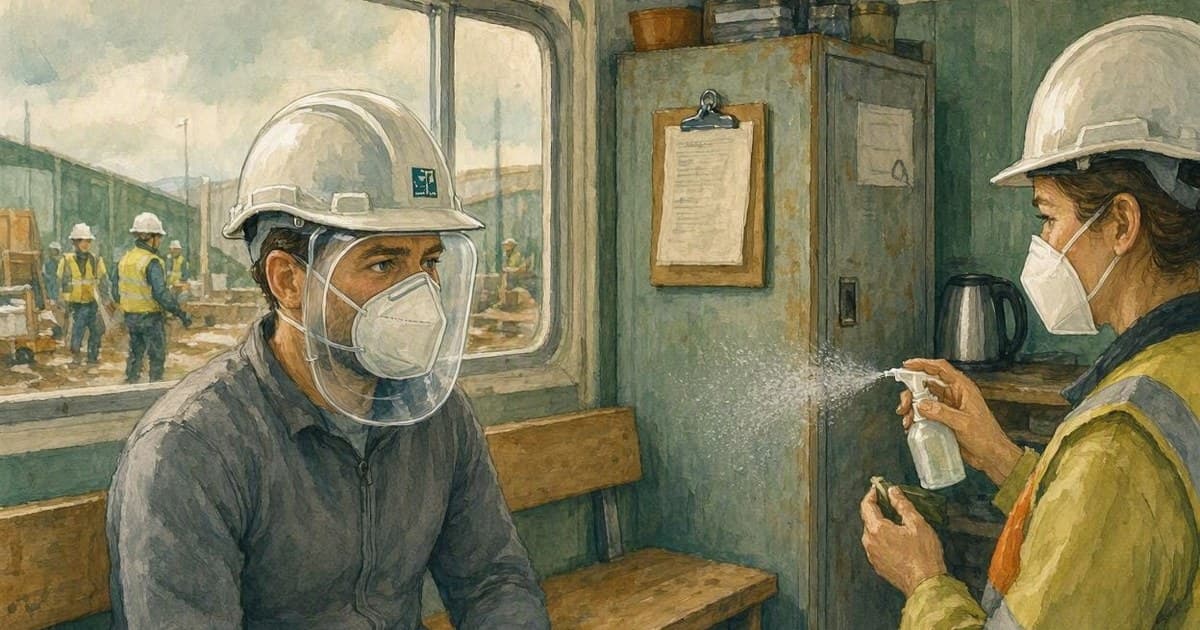
Qualitative fit testing is the hooded test most site workers have experienced. The wearer dons the mask, a hood goes over their head, and a bitter (or occasionally sweet) test solution is sprayed into the hood in controlled quantities while they perform a sequence of exercises — normal breathing, deep breathing, turning the head, talking, bending. If they can taste the solution at any point, the mask is leaking and the test fails. It is a pass/fail method suitable for filtering facepieces like FFP2 and FFP3 disposables and for half masks. Before the test proper there is a sensitivity check without the mask to confirm the person can actually taste the solution at low concentration — skip that and the whole test is meaningless.
Qualitative testing is quick and cheap, and its weakness is that it depends on the honesty and taste perception of the wearer. Done properly by a competent tester following the full protocol, it is a valid method for the mask types it covers.
Quantitative Testing: Counting the Particles
Quantitative testing uses instruments — most commonly an ambient particle counting device — to measure the concentration of particles inside and outside the facepiece during the exercise sequence, producing a numerical fit factor. It removes the subjectivity of taste, produces a printed result, and is the required method for full face masks, where the higher assigned protection factors demand a demonstrated higher standard of fit. It also works for half masks and filtering facepieces, so some employers standardise on it across the board.
Whichever method is used, the outcome attaches to a specific make, model and size. A pass on one manufacturer's FFP3 says nothing about another's. Change the mask you issue, and everyone needs testing again in the new one — a procurement decision that saves pennies per mask can quietly invalidate a site's entire fit testing record.
The Facial Hair Rule
Tight-fitting RPE seals against skin. Anything between the sealing surface and the skin — stubble, beard growth, sideburns crossing the seal line — creates leak paths that no amount of strap tightening closes. The evidence on this is unambiguous: even a day or two of growth measurably degrades protection. So the rule on well-run sites is clean shaven in the area of the seal on every day the mask is worn, not just on test day. Passing a fit test freshly shaven and then working the rest of the week with stubble means the test result no longer describes the wearer.
Where beards are worn for religious or cultural reasons, or an operative simply cannot maintain the seal, the answer is not a waiver — it is loose-fitting RPE. Powered hoods and helmets do not rely on a face seal at all, need no fit test, and in many dusty trades are more comfortable for full-shift wear anyway. The hierarchy question worth asking first, though, is whether the exposure can be engineered down so far that RPE stops being the control you depend on.
Who Can Test, and How Often
Fit testing must be done by someone competent to do it, and the industry benchmark for demonstrating that competence is the Fit2Fit accreditation scheme. Plenty of in-house testers are competent without accreditation, but when a claim or an HSE visit puts your fit testing under scrutiny, an accredited tester's records are much harder ground to attack. Records should capture the person, the exact mask make/model/size, the method, the result, the tester and the date.
Retesting is required whenever something changes that could affect fit: a different mask model or size, significant weight loss or gain, dental work, facial injury — and as a matter of good practice at sensible intervals even without change. Treat the fit test record like a training card: current, specific, and checked at induction rather than assumed.
Making It Stick on Site
The failure mode is rarely the test — it is everything after. Masks stored loose in van doors, worn under the chin between tasks, reused for weeks, or swapped for whatever the merchant had in stock. Build the checks into the routines you already run: RPE condition and correct model on the pre-start checks, fit test currency verified at induction, seal checks demonstrated at the toolbox talk. A fit test is a snapshot; protection is the habit of wearing the tested mask, properly, every time the dust is there.
Build Better Sites with Our Templates
The templates and systems discussed in this article can save your team hours every week. Explore our full product range to find tools that match your workflow.
Explore Products