LOLER Thorough Examination vs Inspection: The Difference That Keeps Catching Sites Out
Two Words, Two Legal Regimes
On site the words get used interchangeably: the excavator has been "inspected", the chains have been "examined", the harness was "checked". Legally they are different animals under different regulations, done by different people at different intervals, producing different documents. Mixing them up is how sites end up with a folder full of paper and a crane with no valid report of thorough examination — which means, in the eyes of LOLER, a crane you cannot lift with.
What a Thorough Examination Actually Is
Under the Lifting Operations and Lifting Equipment Regulations 1998, lifting equipment must have a thorough examination by a competent person — a systematic and detailed examination, including testing where the competent person considers it necessary, to detect defects that are or could become dangerous. The critical point is independence and competence: the competent person needs the practical and theoretical knowledge to find weaknesses, and enough independence from site production pressure to condemn kit without being leaned on. In practice that usually means an engineer surveyor from an inspection body or the insurer, not the fitter who maintains the machine.
The default intervals are fixed by the regulations unless a written examination scheme says otherwise: every 6 months for lifting equipment used to lift people and for lifting accessories — chains, slings, shackles, eyebolts, spreader beams — and every 12 months for other lifting equipment. Thorough examination is also required before first use in certain cases, after installation or reassembly where safety depends on it, and after exceptional circumstances such as damage, failure or long periods out of use. The output is a written report of thorough examination with content prescribed by the regulations, and serious defects get reported to the enforcing authority by the examiner, not filed quietly.
What Inspection Means
Inspection sits mostly under PUWER — the Provision and Use of Work Equipment Regulations 1998 — supplemented by LOLER's own requirement for inspection between thorough examinations where risk assessment says conditions can deteriorate. Inspections are the routine checks done at appropriate intervals by a competent person who can be in-house: the weekly documented inspection of the excavator, the pre-use visual check of slings before a lift, the operator's daily walk-around. Their job is to catch deterioration between the deep-dive examinations — hydraulic weeps, cut sling covers, cracked welds, missing pins.
So the hierarchy on a typical machine looks like this: daily pre-use checks by the operator, recorded; periodic documented inspections, weekly or as your risk assessment determines; and thorough examination at 6 or 12 months by the external competent person. Each layer catches what the layer below cannot, and none of them substitutes for another. A year of immaculate daily checks does not extend a thorough examination by a single day.
The Accessories Problem
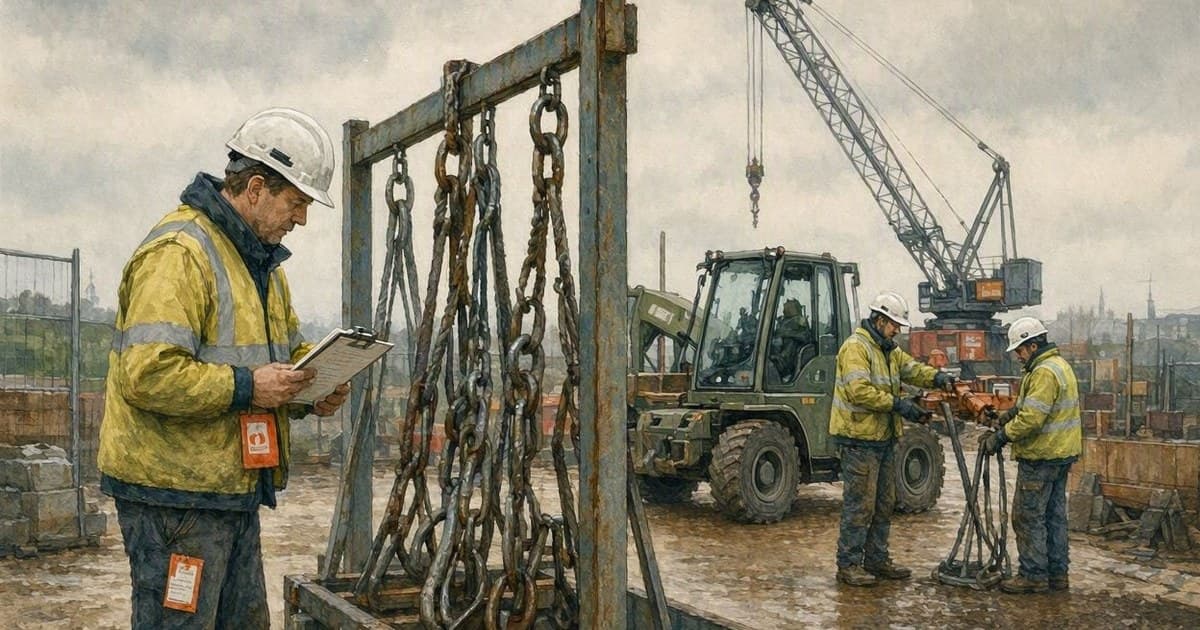
Excavators and telehandlers get looked after because they are big, expensive and hired. The kit that gets sites in trouble is the small stuff: the chain set that arrived with a subcontractor, the shackles in the bottom of the van, the lifting eyes cast into a precast unit. Every accessory needs its 6-monthly thorough examination and needs to be identifiable — which is what the ID tags and colour-coding schemes are for. A colour code is not a legal requirement in itself; it is a visual management tool that lets a banksman glance at a sling and know it is inside its examination window. If your site runs a colour code, the current colour needs to be displayed where riggers can see it, and anything wearing the wrong colour comes out of service on the spot.
Quarantine matters more than paperwork here. A condemned or out-of-date sling left hanging on the rack will be used — not maliciously, just by someone in a hurry who saw a sling. Cut it, tag it, bin it or lock it away.
Excavators Used for Lifting
The perennial grey area: a 360 lifting pipes into a trench is lifting equipment doing a lifting operation. That drags in LOLER — thorough examination requirements, check valves and rated capacity indicators as applicable, a lift plan proportionate to the operation, and an appointed person behind the planning. The machine's 12-month thorough examination as an excavator does not automatically cover object lifting if the examination scheme excluded it, and the quick-hitch and lifting point are part of the load path. If your excavators routinely lift, make sure the examination reports actually say so.
Making the System Auditable
When an inspector or a principal contractor's auditor arrives, they will ask three questions about any piece of lifting kit: where is the current report of thorough examination, where are the interim inspection records, and how do you know this specific item is the one on that report? Sites that answer in seconds have a register — every item of lifting equipment and every accessory listed with its ID, examination dates, next-due dates and current status, with the reports attached. Sites that answer in days have a drawer. The register also does the forward-looking job the drawer never does: flagging what falls due next month so examinations get booked before kit goes out of date mid-lift, not after.
Build Better Sites with Our Templates
The templates and systems discussed in this article can save your team hours every week. Explore our full product range to find tools that match your workflow.
Explore Products