Manual Handling on Site: TILE Assessments, the 25kg Myth and Controls Beyond 'Bend Your Knees'
The Regulation Everyone Misquotes
Ask around site and you will hear that the legal manual handling limit is 25kg. There is no such limit. The Manual Handling Operations Regulations 1992 set a hierarchy instead: avoid hazardous manual handling so far as is reasonably practicable; assess what cannot be avoided; and reduce the risk of injury so far as is reasonably practicable. The 25kg figure comes from HSE guidance filter diagrams — a screening value for a load held close to the body at waist height by a standing man in ideal conditions, dropping sharply for lifting at arm's length, above shoulder height, below knee height, when twisting, or when repeated. The same charts give lower baseline figures for women. These are filters for deciding whether a detailed assessment is needed, not permissions. A 20kg lift can be high risk done badly and repeatedly; a heavier team lift with the right aids can be fine.
The injury bill explains why the regulations aim at the task rather than a number: musculoskeletal disorders remain among the biggest causes of working days lost in construction, and they arrive two ways — the acute lift that goes wrong, and the cumulative damage of a thousand awkward handlings that were each individually "fine".
TILE: The Assessment That Fits on One Page
Task — what the movement actually involves: distances, heights, twisting, stooping, reaching, frequency, rest opportunity. Carrying kerbs 40 metres because the wagon dropped them in the wrong place is a task problem, and the fix is where the wagon drops them. Individual — who is doing it: strength and stature vary, new and returning workers are more vulnerable, existing injuries and pregnancy change the answer, and training changes what is reasonable to ask. Load — weight, but also size, grip, stability and sharp edges. An awkward 15kg with no handholds beats a compact 25kg for injury potential. Is the weight even known? Marked? Environment — the part construction supplies in abundance: uneven and sloping ground, mud, trench edges, restricted spaces, weather, poor light, and the obstacle course between the stack and the workface.
A TILE assessment for a site task takes minutes and belongs inside the RAMS for the activity, not in a separate binder. Its output is not a score — it is the list of changes: what gets mechanised, what gets moved closer, what becomes a two-person lift, what gets ordered differently.
Controls That Actually Work
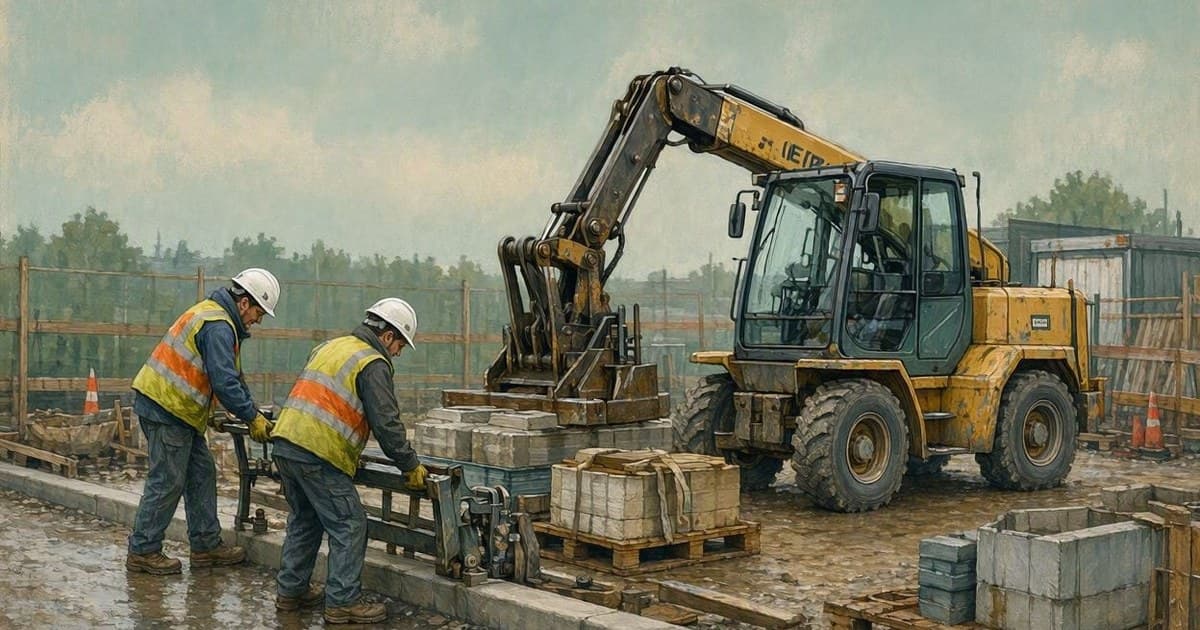
The hierarchy starts with avoid, and avoidance in construction is mostly logistics and procurement decided long before anyone bends their knees. Deliveries placed by crane, hiab or telehandler to the point of use. Lifting points and mechanical handling designed into precast elements. Lighter alternatives specified — smaller bags, half-size boards, lower-weight blocks where the spec allows. Ordering to size so units are not cut and re-carried. Every load that arrives where it is needed is a manual handling assessment you never have to write.
Then reduce: mechanical aids matched to the task and actually available — pallet trucks, trolleys, kerb lifters, slab grabs, vacuum lifters, wheelbarrows with decent tyres on decent runs; team lifts that are organised rather than improvised, with one person calling it; work areas set out so storage sits between knee and shoulder height and the carry distance is short; rotation so the same pair of shoulders does not do the whole repetitive task; and housekeeping, because half the injury risk in the E of TILE is simply what is left lying in the walking route.
Training belongs at the bottom of the list, not because technique is worthless but because it is the control that remains after the better ones are exhausted. "Bend your knees" cannot fix a task that should have been mechanised, and an assessment whose only action is a training refresher has usually not been done honestly.
Making It Stick
Manual handling improves when it is managed like production, because it is production: materials logistics, delivery planning and storage layout decide most of the risk. Put handling on the pre-start conversation for heavy trades, watch the task rather than the paperwork on inspections — the assessment says two-person lift; is that what is happening? — and treat every soft-tissue injury and near-miss as data about a task, not a verdict on a back. The sites with the fewest strains are rarely the ones with the thickest manual handling files. They are the ones where the wagon drops the kerbs at the workface.
Build Better Sites with Our Templates
The templates and systems discussed in this article can save your team hours every week. Explore our full product range to find tools that match your workflow.
Explore Products