Silica Dust on Construction Sites: The 0.1 mg/m3 Limit and Controls That Actually Work
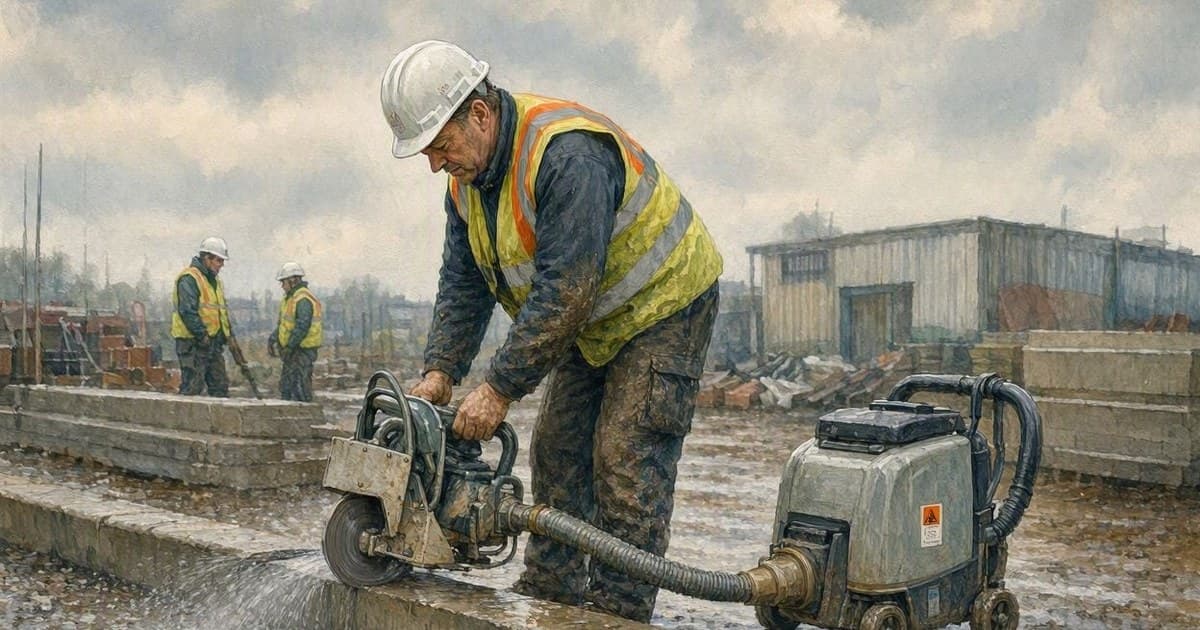
The Dust You Cannot See Is the Problem
The dust cloud behind a cut-off saw looks dramatic, but the particles that scar lungs are the ones too small to see. Respirable crystalline silica — RCS — is the fine fraction generated when concrete, mortar, brick, block, stone and aggregates are cut, drilled, ground, scabbled or crushed. Particles small enough to reach the deep lung cause silicosis, contribute to chronic obstructive pulmonary disease, and are a recognised cause of lung cancer. The HSE's long-standing estimate is that silica is second only to asbestos among occupational lung disease killers in construction — hundreds of deaths a year, all of them slow, all of them preventable.
The workplace exposure limit under COSHH is 0.1 mg/m³ as an 8-hour time-weighted average. To picture how small that is: spread evenly through the air of a typical site cabin, the full daily allowance would weigh less than a grain of salt. Common tasks blow through it in minutes — dry cutting a concrete kerb with no suppression can expose the operator to concentrations many times the limit. That is the arithmetic that makes "it's only a couple of cuts" the most dangerous sentence in the compound.
Which Tasks Generate the Most RCS
The worst offenders are the high-energy tools on high-silica materials: cut-off saws on concrete and stone, wall chasers, concrete grinders and scabblers, dry sweeping of concrete dust, crushing operations, and abrasive blasting. Concrete and sandstone are particularly rich in crystalline silica; brick and mortar somewhat less so but still well capable of overexposure. Enclosed and poorly ventilated locations multiply everything — the same cut that is bad in open air is far worse in a basement, a chamber or a tunnel, and the dust hangs around for whoever comes next.
The Control Hierarchy, Applied Honestly
Eliminate and Substitute First
The cheapest silica control is the cut that never happens. Order blocks to size, use pre-cut or modular components, set out so units land on full dimensions, choose a block splitter over a saw where the finish allows. Design-stage choices — different materials, cast-in openings instead of drilled ones — remove exposure for every trade that follows. None of this feels like dust control, which is exactly why it gets forgotten.
Water Suppression
Wet cutting knocks dust down at the point of generation and is the standard control for cut-off saws and floor saws. It only works when the water actually flows for the whole cut at the right rate — a half-empty bottle pressurised once at the start of the shift is theatre. Check the feed, check the flow, and remember the slurry left behind dries into a silica dust reservoir; clean it up wet.
On-Tool Extraction
Grinders, chasers, drills and sanders take shrouds connected to extraction units, and the classification of the vacuum matters: construction dust containing silica calls for an M class unit as the general standard, not a domestic vacuum that recirculates the fine fraction straight back into the room. The shroud has to actually enclose the work, the hose has to be intact, and the filters have to be maintained — a clogged extractor is a heavy bucket, not a control.
RPE as the Final Layer
Even good engineering controls usually leave residual exposure on the dustiest tasks, so RPE rides on top — typically FFP3 or better for silica work, face fit tested to the individual, worn for the whole exposure including the clean-up. RPE is the last line, not the plan: if the risk assessment jumps straight from "cutting concrete" to "wear a mask" with nothing in between, it is not a COSHH assessment, it is a disclaimer.
Assessment, Health Surveillance and Proof
A silica COSHH assessment worth the name identifies the tasks, the materials, the duration and the controls, and reaches a defensible judgement about exposure against the WEL — using published task-based data or exposure monitoring where the answer is not obvious. Where there is regular exposure to RCS and a reasonable likelihood that silicosis could result, health surveillance comes into play, typically questionnaires and lung function testing through an occupational health provider, with chest X-rays where indicated. Surveillance does not protect anyone by itself, but it catches disease early and it audits your controls: if surveillance keeps finding early changes, the controls are failing.
Finally, make the system inspectable. The questions an inspector asks are concrete: show me the assessment for this task, show me the extraction unit's test records, show me this operative's face fit and the surveillance programme. Sites that manage silica well can answer from records in minutes — and their answer to "it's only a couple of cuts" is the same every time: then it will only take a minute to do it wet.
Build Better Sites with Our Templates
The templates and systems discussed in this article can save your team hours every week. Explore our full product range to find tools that match your workflow.
Explore Products