Working Near Overhead Power Lines: GS6, Goalposts and the Flashover Nobody Expects
Contact Is Not Required
The fact that reorganises your thinking about overhead lines is this: high-voltage electricity can jump. Bring a tipper body, an excavator boom or a scaffold tube close enough to a high-voltage conductor and the air gap can flash over before anything touches. Add the invisible sag of a line on a hot day, the sway in wind, and an operator's honest inability to judge height against sky, and you have the reason overhead line contact remains one of the reliable killers in construction and agriculture alike. The HSE's guidance note GS6 exists for exactly this scenario — work near overhead lines — and its logic is a strict hierarchy: avoid the area, or make the line dead, or engineer the work so nothing can get close.
Start With the DNO, Not the Tape Measure
Every plan for work near overhead lines starts with the line's owner — the distribution network operator, or National Grid for transmission lines. They will tell you the voltage (which you cannot judge by looking), whether the line can be diverted or switched off for the works, and their requirements for working in proximity. Never assume a line is dead, low-voltage, or insulated because it looks it; and never assume it is telecoms because it is the lowest wire on the pole. Diversion or isolation is the clean answer and needs raising early — DNO lead times are measured in weeks and months, not days, which is why the conversation belongs in pre-construction planning rather than the week the muck shift starts.
If the line stays live, GS6's control scheme takes over: decide the areas where plant and people must not go, and build physical management that makes straying difficult rather than merely prohibited.
Exclusion Zones, Barriers and Goalposts
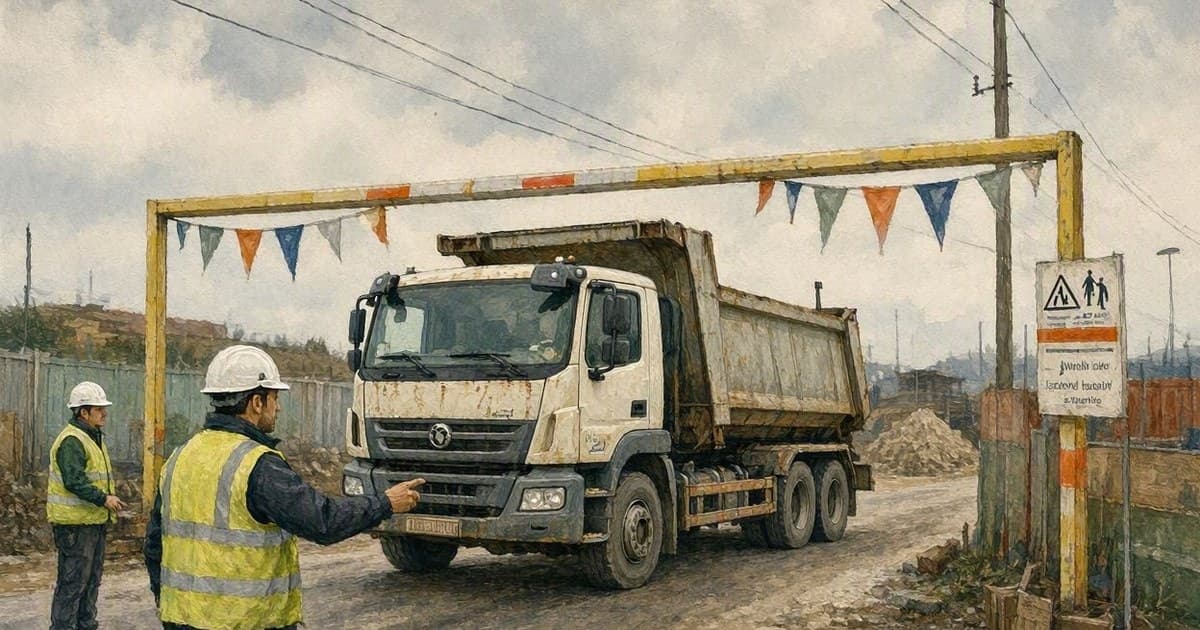
Where work must happen near a live line, the ground-level controls are barriers defining the safe corridor and goalposts controlling every crossing point. The barriers run parallel to the line at a distance set by the risk assessment with the DNO's input — GS6's baseline figures put ground-level barriers at least 6 metres from the line for most distribution lines, further where tower lines, tipping bodies or long-reach plant are involved, and always adjusted for what your plant can actually reach. Crossings for plant go through defined gateways only, framed by rigid goalposts set to a safe passage height, with the crossing at right angles and the surface maintained so nothing bounces. The height restriction is communicated in the cab, not just on the post: bunting and warning signs on the approach, the crossing height on the induction and in the traffic management plan, and tipper drivers specifically briefed that body up is how most of these incidents happen — the run under the line with the bed still raised.
Two failure patterns account for most near-misses. First, the exclusion zone that quietly erodes: materials stored against the barriers, then over them, then plant working from the stockpile inside the zone. Second, the task nobody mapped: the concrete pump repositioning, the crane oversail during a lift planned for somewhere else, the scaffold going up for a job priced after the barriers were. Any new activity near the line goes back through the assessment — the barriers were designed for the site as it was, not as it has become.
If Contact Happens
Brief every operator on the contact drill before they need it, because instinct gets it wrong. If plant contacts a line, the operator stays in the cab and moves the machine clear if it is safe and possible. If they must get out — fire, for instance — they jump clear without touching machine and ground at the same time, land with feet together, and move away in small shuffling steps or hops: after a line comes down, the ground itself carries voltage that falls off with distance, and a normal stride can put a lethal difference between your two feet. Everyone else stays well back and keeps others back; the line is treated as live even if it looks dead, because reclosers can re-energise a tripped line automatically. Call 999 and the DNO's emergency number — which should be on the site emergency board precisely for this moment — and nobody approaches until the DNO confirms the line is dead and earthed.
The Planning Standard
The test for your overhead line arrangements is the same as for any high-consequence control: does the physical site make the safe behaviour the easy behaviour? Barriers a machine cannot casually cross, goalposts at every crossing, storage banned from the corridor, heights in the cab and in the induction, the DNO consulted and their answer on file, and the contact drill briefed. Do that and a live line over your site becomes a managed constraint. Skip it and you are relying on every driver, every day, judging a distance the human eye cannot judge — against a hazard that does not need to be touched to kill.
Build Better Sites with Our Templates
The templates and systems discussed in this article can save your team hours every week. Explore our full product range to find tools that match your workflow.
Explore Products